
Indian skin doesn't fit into one neat box. It runs from fair ivory to deep espresso, and within every one of those depths, the underlying warmth of the skin is the undertone what really decides which colours will make you glow and which ones will leave you looking flat. This guide breaks the whole thing down: how to find your undertone, which colours suit each skin depth, and a few universal shades that flatter almost everyone.
Skin Tone vs. Undertone: Know the Difference
Skin tone is the depth you see on the surface — fair, wheatish, medium, tan, dusky, or deep. It can shift with the seasons and sun exposure.
Undertone is the subtle colour beneath the surface — warm, cool, or neutral. It's biological and doesn't change, no matter how tanned you get.
Undertone is the more important factor for choosing colours, because two people with the same surface tone can need completely different palettes if their undertones differ.
How to Find Your Undertone
You don't need a professional stylist to figure this out — a few quick checks in natural daylight will get you most of the way there.
The Wrist Vein Test
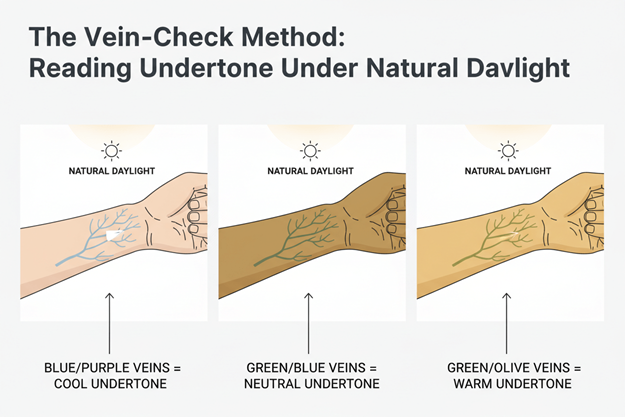
Look at the veins on the inside of your wrist.
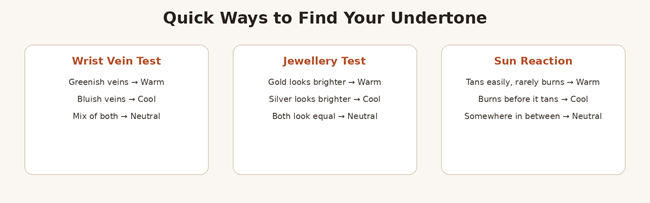
Greenish veins → warm undertone
Bluish or purplish veins → cool undertone
A mix of both → neutral undertone
Greenish veins → warm undertone
Bluish or purplish veins → cool undertone
A mix of both → neutral undertone
The Jewellery Test
Notice which metal makes your skin look brighter.
Gold flatters warm undertones
Silver flatters cool undertones
Both work equally well on neutral undertones
Warm Undertones (yellow, golden, olive base)
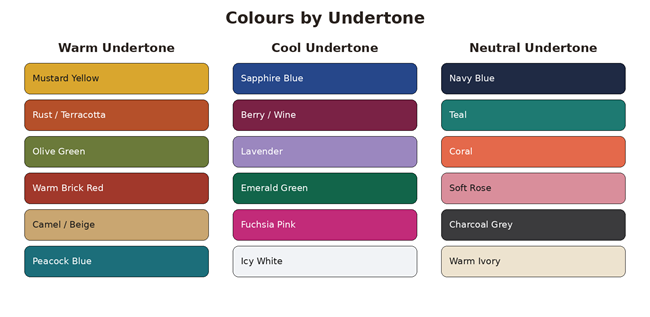
Warm undertones glow in colours that echo that golden base rather than fight it: mustard yellow and saffron, rust and terracotta, olive and bottle green, warm reds like brick or tomato, camel and warm browns, and emerald or peacock blue. Cool, icy shades — think baby blue or ash grey — can sometimes look slightly dull against warm skin unless balanced with warmer accessories or makeup.
Cool Undertones (pink, blue, red base)
Cool undertones look brightest in colours with a blue or pink base: sapphire and cobalt blue, berry and wine, lavender and soft violet, emerald and forest green, fuchsia and cool pink, and crisp white or icy pastels.
Neutral Undertones (a balanced mix)
If you can't quite tell whether your veins lean green or blue, you likely have a neutral undertone — and that's genuinely good news, because it means most colour families work for you. The main thing to play with is intensity and contrast rather than temperature: navy, teal, coral, and soft rose all tend to sit well on neutral skin.
Colours by Skin Depth
Undertone tells you the family of colours to reach for; skin depth affects how bold you can go within that family.

Fair Skin
Fair Indian skin has the widest playing field. Soft pastels — blush pink, mint, lavender, powder blue — read as fresh and pretty, while deep jewel tones like sapphire, emerald, and burgundy create striking contrast. Ivory or off-white often looks more flattering than stark white, which can wash out very fair complexions.
Wheatish / Medium Skin
This is one of the most common tones across India, and it responds beautifully to warm, earthy, and jewel shades: mustard, rust, olive, emerald, royal blue, and deep maroon all bring out the skin's natural golden glow. Pale, washed-out pastels are the one category to be a little careful with, since they can sometimes look flat rather than fresh.
Dusky / Deep Skin
Dusky and deep skin tones can carry rich, saturated colour with real confidence. Deep red, rust, gold, royal blue, magenta, and metallics all look luminous rather than overpowering. Bright white and warm ivory also create a striking, elegant contrast against deeper skin — so don't shy away from it.
Colours That Work Across Almost Every Indian Skin Tone
A handful of shades show up again and again as safe, universally flattering choices, regardless of undertone or depth:

Emerald green — its slight golden warmth flatters both warm and neutral skin
Navy blue — creates contrast against lighter skin and depth against darker skin
Mustard yellow — long considered auspicious in Indian tradition and genuinely glow-giving on warm undertones
Maroon / deep wine — pairs beautifully with dark hair and eyes
Warm ivory or off-white — softer and more flattering than stark white for most Indian complexions
Cobalt or royal blue — reads as neither strictly warm nor cool, so it sits well on almost anyone
A Few Practical Styling Notes
Distance from the face matters. Bottoms, dupattas, and linings can be almost any colour — it's the shade closest to your face (blouse, kurta top, shirt) that has the biggest visual impact.
Lighting changes everything. Standard indoor bulbs often carry a yellow or blue cast that distorts how a colour actually looks on you. Always do a final check in natural daylight before committing to an outfit.
Muted vs. bright isn't about "rules." A "wrong" colour used as a print, trim, or accent often works fine even if it wouldn't as a solid block near your face.
Confidence is a colour, too. These are guidelines, not laws — plenty of people look wonderful in shades that supposedly "shouldn't" suit them. If a colour makes you feel genuinely good, that counts for a lot.
Leave a Comment
Your email address will not be published. Required fields are marked *